Ghana’s National AI Strategy Gets Cabinet Approval — KNUST Led the Charge and France Just Pledged €12 Million More
After four years of consultations, ethical debates, and multi-stakeholder engagements coordinated by KNUST's Responsible AI Lab, Ghana's National Artificial Intelligence Strategy received Cabinet approval in February 2026. France has followed with a €12 million second-phase investment in AI research at KNUST, and the government has declared AI a national development priority with a target to make Ghana the AI Hub of Africa.

Four Years in the Making
Ghana’s National AI Strategy has been formally approved by Cabinet — a milestone that closes a four-year journey that began in a Kumasi conference room in March 2022. At that inaugural meeting, Professor Jerry John Kponyo, Principal Investigator and Scientific Director of the Responsible Artificial Intelligence Lab (RAIL) at KNUST, presented a frank assessment of Ghana’s AI landscape: the country had vast data potential but lacked the governance frameworks, institutional infrastructure, and ethical guidelines needed to deploy AI responsibly at scale.
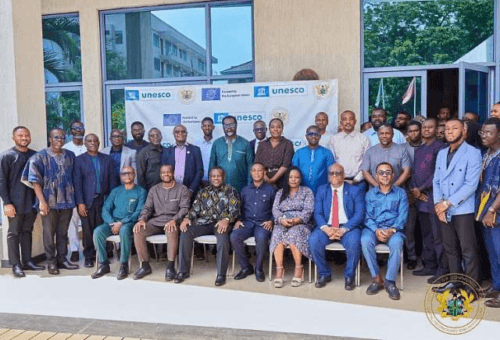
From that starting point, KNUST’s RAIL coordinated a structured national consultation process. A first consultation at the AH Hotel in East Legon engaged government officials, academia, industry leaders, civil society, and tech innovators. A second consultation at KNUST in Kumasi in April 2025 broadened engagement to development partners. A third consultation focused specifically on Ghana’s judiciary — recognising that AI governance requires constitutional and legal clarity to be meaningful.
“Data alone isn’t enough. It’s the intelligence we apply that will revolutionise healthcare, smart cities, and financial inclusion.” — Samuel Nartey George, Minister of Communications, Digital Technology and Innovations
KNUST: The Academic Backbone of Ghana’s AI Ambition
KNUST Vice-Chancellor Professor Rita Akosua Dickson has been a consistent champion of the process, describing the strategy consultations as efforts to produce “a plan that is all-inclusive, forward-thinking, responsible and grounded in Ghana’s unique developmental context.” The university announced an “AI in Education” Summer School for October 2025 aimed at building a competent national AI workforce — part of a broader effort to ensure the strategy is backed by human capital, not just policy documents.
The university’s AI for Sustainable Development (AI4SD) programme — implemented with the Ghana Atomic Energy Commission, France’s Université Paris-Saclay, and the French National Centre for Scientific Research (CNRS) — has already produced tangible applied research. The RAIL team has developed a Crop Disease Detection Toolbox that uses leaf colour analysis to diagnose agricultural diseases for smallholder farmers; an AI system to predict transformer faults in partnership with GRIDCo; and AI-powered sensors to monitor chemical turbidity in water bodies polluted by illegal mining. A Smart Indigenous Weather App is also in development.

France’s €12 Million Bet on Ghana’s AI Future
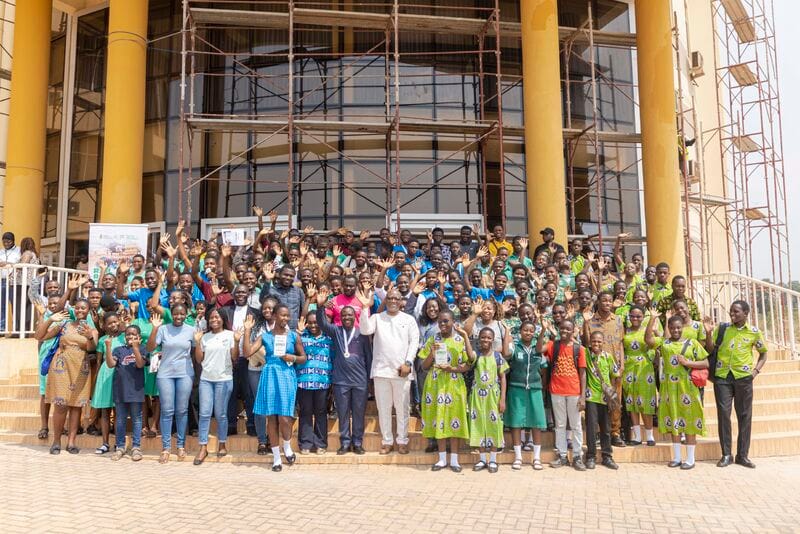
In a ceremony at KNUST’s newly renovated Innovation Hub, the French Embassy in Accra, KNUST, and France’s Université Paris-Saclay formally launched the second phase of the AI4SD programme. The three-year, €12 million investment is aimed at equipping Ghana’s next generation with technical skills and entrepreneurial know-how to translate AI research into locally relevant solutions. French Ambassador Diarra Dimé-Labille described the programme as “a cornerstone of France’s broader commitment to promoting digital innovation in West Africa.”
The partnership reflects a growing recognition among European development partners that Ghana’s combination of democratic stability, growing tertiary education capacity, and a vibrant startup ecosystem makes it one of Africa’s most compelling AI development bets. The IDRC, GIZ’s FAIR Forward initiative, and the British High Commission have all contributed to Ghana’s AI strategy process, making it one of the most internationally supported national AI frameworks on the continent.
The Economic Case: $20 Billion GDP Boost?
Mr. Darlington Akogo, CEO of MinoHealth AI Labs — one of Ghana’s most prominent AI-driven health companies — made a bold economic argument during a national AI consultation, estimating that AI could boost Ghana’s GDP by $20 billion. “AI offers higher returns than traditional assets like cocoa and oil — and it will enhance these very sectors,” he argued. While that figure requires scrutiny, PwC’s global modelling consistently places AI’s economic impact in developing markets at significant multiples of current GDP — and Ghana, with its gold, cocoa, oil, and fintech sectors, has concrete AI use cases at scale.
The government is pairing the cabinet-approved strategy with two flagship programmes. The 1 Million Coders Programme, announced by Minister George, aims to equip Ghanaian youth with future-ready digital skills — positioning the country to train the next generation of AI practitioners domestically rather than relying on foreign talent. The 24-Hour Economy agenda, meanwhile, explicitly envisions AI as an enabler of round-the-clock productivity in manufacturing, logistics, and services.
The Road Ahead: Governance, Ethics, and Inclusion
Cabinet approval is the beginning, not the end. Ghana’s AI strategy is built on three pillars: harnessing AI for economic transformation; ensuring responsible deployment with strong ethical frameworks and data protection; and guaranteeing inclusion — so that AI benefits reach women, rural communities, and people with disabilities, not just urban elites. Dr. Arnold Karvaapuo of the Data Protection Commission described the strategy as “a blueprint for Ghana’s digital future,” but added that enforcement of data governance rules will be critical.
Ghana’s AI framework will be tested on execution. The country enters 2026 with Cabinet approval, €12 million in research funding, an ongoing 1 Million Coders Programme, and a newly energised KNUST research ecosystem. What it needs next is robust implementation — public-private data partnerships, enforcement of AI ethics standards, and a regulatory sandbox that allows innovation without exposing citizens to unprotected algorithmic systems. The strategy’s 2023–2033 timeframe gives Ghana a decade to prove it can turn policy into practice.